

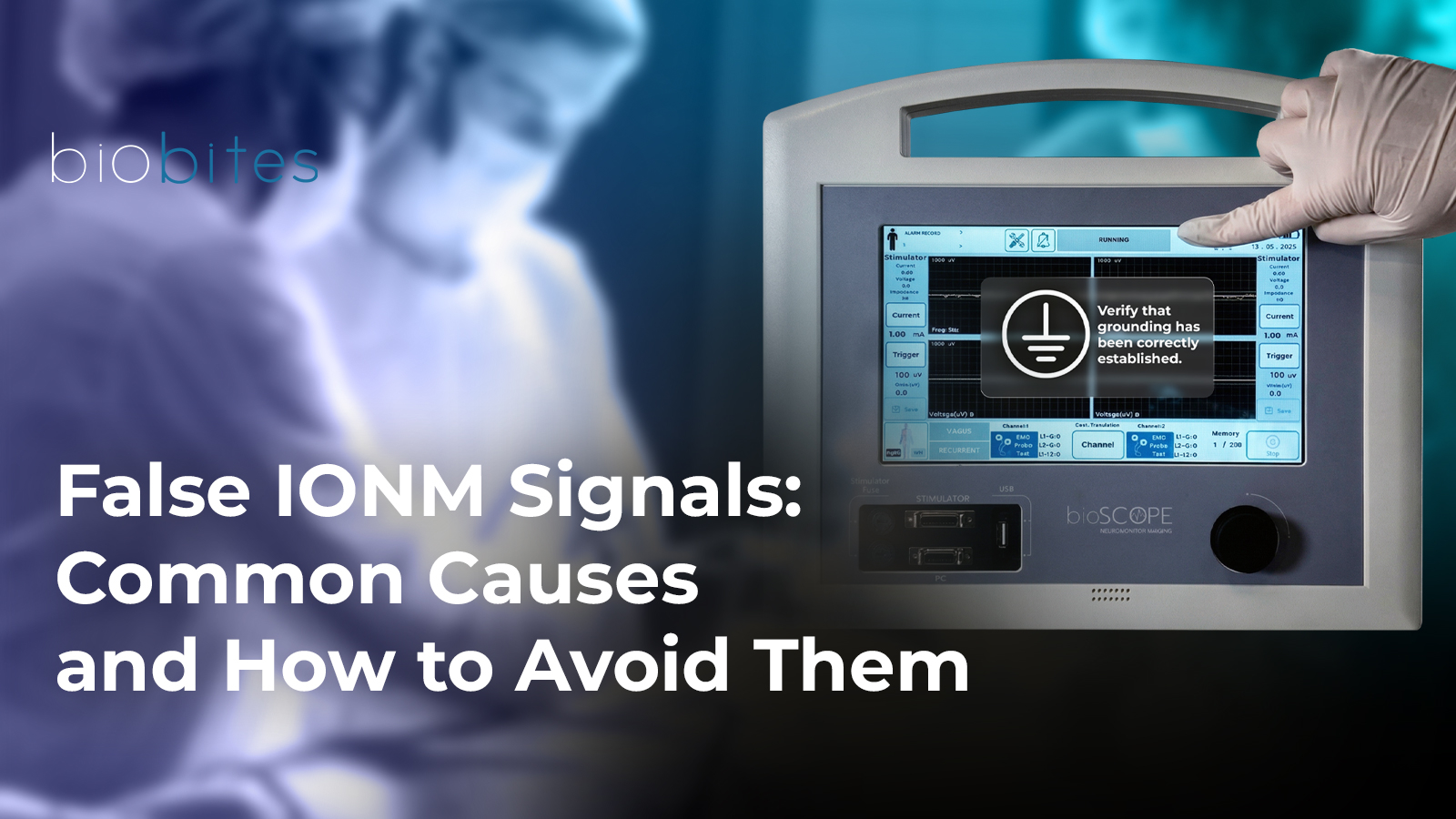
False IONM signals refer to situations in which signals recorded during intraoperative neuromonitoring do not accurately reflect true neural injury. These false-positive signals may arise from technical artifacts, improper electrode placement, or equipment configuration errors, potentially leading to unnecessary alarms and concern among the surgical team.
Because such signals can influence intraoperative decision-making, accurate application and careful interpretation of neuromonitoring are of critical importance.
What Are False IONM Signals?
False IONM signals are defined as signal changes observed during intraoperative neuromonitoring that do not correspond to actual neurological injury.
These signals may trigger alerts despite the absence of true neural damage, often due to technical factors, device-related artifacts, or physiological influences. Therefore, signal interpretation should always be performed in conjunction with surgical and anesthetic context.
Common Technical Causes of False IONM Signals
Technical causes of false IONM signals include inadequate electrode insulation, electromagnetic interference, and suboptimal device parameter settings.
These factors may produce signal fluctuations or alarms without any true neurological change. For this reason, proper technical setup and calibration are essential to ensure reliable monitoring.
Electrode Placement and Impedance Issues
Improper electrode placement or insufficient tissue contact can result in poor signal quality and increased impedance values, leading to signal loss or artifacts.
Impedance reflects the electrical interface between the electrode and the tissue. Elevated impedance typically indicates inadequate conduction and may compromise signal reliability. In clinical practice, impedance values are generally expected to be balanced and within the range of approximately 2–5 kΩ.
Careful electrode positioning and impedance control are therefore critical for accurate signal acquisition.
Anesthesia-Related Signal Changes
Anesthetic agents, particularly inhalational anesthetics, may reduce MEP and SSEP amplitudes, leading to signal attenuation or loss. These effects depend on the depth of anesthesia and the type of agent used, which can complicate signal interpretation.
For this reason, total intravenous anesthesia (TIVA) is commonly preferred during IONM. In cases of sudden signal change, anesthetic factors should always be evaluated before assuming surgical injury.
How to Avoid False Signals in Intraoperative Neuromonitoring
To minimize false IONM signals, technical factors such as electrode placement, device settings, and patient positioning should be carefully controlled.
In addition, continuous communication between the surgical team and the neurophysiology team is essential for real-time signal assessment. Standardized protocols and appropriate anesthetic techniques help reduce the incidence of false alarms.
Practically, rapid verification of electrodes, anesthesia status, and stimulation parameters is a key step in distinguishing false alarms from true signal changes.
FAQ
- How can false IONM signals be distinguished from true neural injury?
Technical factors and anesthetic conditions should be rapidly assessed and interpreted together with surgical findings. - Can anesthesia cause false IONM signals?
Yes, particularly inhalational agents, which may reduce signal amplitudes. - Can false signals be completely prevented?
No, but their frequency can be significantly reduced with appropriate protocols and experience.
References
- MacDonald, D. B. (2006). Intraoperative motor evoked potential monitoring: Overview and update. Journal of Clinical Monitoring and Computing, 20(5), 347–377.
- Skinner, S. A., & Holdefer, R. N. (2014). Intraoperative neuromonitoring: Technical aspects and common pitfalls.Neurosurgical Focus, 37(5), E7.
https://thejns.org/focus/view/journals/neurosurg-focus/37/5/article-pE7.xml - Sutter, M., Eggspuehler, A., Grob, D., et al. (2007). The influence of anesthesia on intraoperative neuromonitoring signals. Spine, 32(22), 2365–2371.
https://journals.lww.com/spinejournal/Abstract/2007/10150
- Nuwer, M. R., Emerson, R. G., Galloway, G., et al. (2012). Evidence-based guideline update: Intraoperative spinal monitoring. Neurology, 78(8), 585–589.
https://n.neurology.org/content/78/8/585